 Lapis Lazuli is a rock, a contact metamorphoses limestone that contains lazurite. It also is known to contain pyrite, the added sparkle of golden-yellow and white flakes of calcite. Other trace minerals can include hauuyne, sodalite, diopside, feldspar, mica, apatite, and zircon just to name a few. The stone was once powdered and mixed with oil to produce the pigment ultramarine(literally, 'beyond the sea'), which is seen in the beautiful blues of Renaissance paintings. Lapis is Latin for “stone”. The names of both lazulie and lazurite are derived from the Persian word Lazbuward and Latin word Lazulum, meaning “blue” or “heaven”. The lapis lazuli name, often shorted to lapis, is sometimes mistakenly used for the mineral lazurite.
 The ancient Egyptians used it extensively in religious ceremonies, and lapis items were found in the tomb of Tutankhamen. It was a popular stone in Mesopotamia, Persia, and the ancient city of Ur, which had a large trade in lapis lazuli. The Greeks and Romans used it as a reward for bravery. The ancients also employed it for inlaid work and for jewelry, amulets, and talismans.
The value of lapis lazuli is largely determined by the abundance and color of the dark intense blue lazurite. The colors range from greenish-blue to purple-blue. The flecks of gold pyrite and white calcite can often increase the value or, when too numerous or too large, decrease it.
This new design features deep blue lapis lazuli stones with flecks of pyrite, disks of natural kyanite, faceted crystals and at the center an old style metal cloisonne round pendant; the blue hues bring out the best in the lapis and kyanite.

Traditionally Lapis Lazuli Properties: Wisdom, intuition, awareness, objectivity, clarity, creativity, expanded consciousness, dreams, purity, courage, serenity.




.jpg)

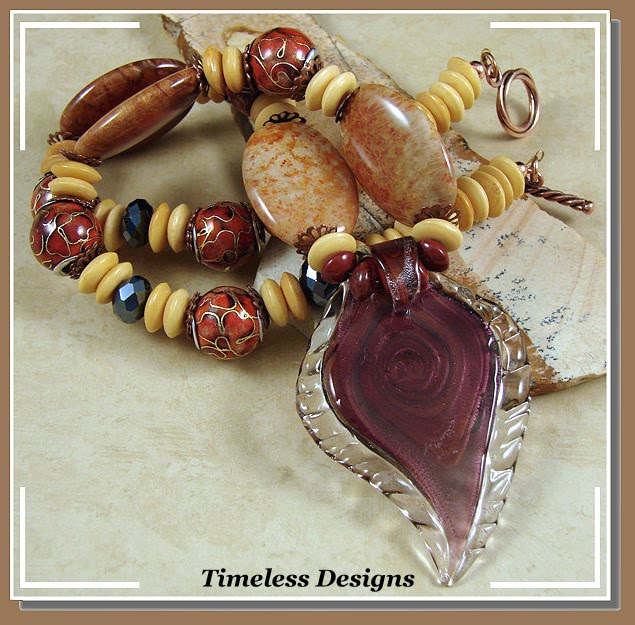
 Agates: Balancing physical, emotional, intellectual and spiritual energies; perceptiveness, strength, inspiration, awakening talents.


 Lampwork beads Magnesite faceted Crystals Copper Set
 Sponge Coral Glass Pearls Brass Wired Earrings Set
 Wild Horse Magnesite Ivoryite faceted Crystals Silver Set


