Showing posts with label Jamie Drake. Show all posts

Monday, 19 July 2010

Speaking of Lucite...

I think that Lucite (or clear acrylic) is a bit of a tricky element in the design world. Sure, it's fun and irreverent, but it can also veer all too easily into seriously tacky territory (see also, stripper shoes). But, like most other things in design (both interior design and in fashion) it's really all about context. Put Lucite in the right setting and it can be wildly successful (see also, Prada, Michael Kors), but pair it with too much animal print, patent leather and uplights, and you've suddenly found yourself in some terrible '80s flashback.

So how then, can you get it right? While my advice for fashion is pretty simple (keep the rest of your outfit relatively conservative, and keep the Lucite confined to a (preferably lower and chunkier) heel, I think it's worth delving into the question in a bit more detail when it comes to design.

As with a single outfit, it's best to keep your Lucite pieces in a single room to a minimum. Just as you wouldn't want every hard surface in your room in the same, dark wood, so too do you want to eschew matching your Lucite coffee table to your Lucite side table to your Lucite lamp....you get the idea. Keeping your Lucite pieces to only one or two standouts allows them to be the stars that they are. Here, DC-based designer Sally Steponkus successfully incorporates a Lucite coffee table into an otherwise fairly formal, traditional living room. The Lucite injects a youthful, more lighthearted note.

Lonny

There are a ton of wonderful examples of designers incorporating acrylic coffee tables into their designs available on the web to inspire you. I particularly love using an acrylic coffee table when the room is tight on space as it almost disappears, avoiding that cluttered/cramped look I generally dislike. Like glass or mirrors, Lucite is a great material to use when you want to add function, without taking up any visual space.

A pair of small acrylic side tables work beautifully as a single coffee table, allowing an uninterrupted view of a particularly striking rug while the two smaller tables give you maximum flexibility to move them around when entertaining.

Leslie Klotz via House Beautiful

The shape of this coffee table is particularly stunning, but its clear base means it doesn't compete with the bold fabric choices on the bench, club chair and pillows.

Ken Fulk

Another great example of how Lucite works particularly well when you don't want to lose sight of a particularly striking rug. I also love the tension in this room between the thoroughly modern coffee table and zebra hide against the much more traditional moldings and upholstered pieces.

I'm so charmed by the idea of a Lucite trunk. The visual joke of having closed storage be completely transparent strikes me as particularly fresh. I'd do as this homeowner did here and fill it with my favorite books and/or magazines.

Of course tables aren't the only place where Lucite is welcome. Lucite seating can also be incredibly attractive. I love these Lucite barstools, with their upholstered seats and I think they work particularly well in this more traditional kitchen. If you're looking for a similar look, you could always add an upholstered seat to these Kartell charles ghost stools.

Jamie Drake

I don't think you can ever go wrong with an acrylic chair for your desk. It's practically foolproof, though I do think it's best to pair these chairs with more traditional tables and desks. Remember: it's contrast that creates interest!

Having said that though, I do think a Louis ghost chair from Phillipp Starck works beautifully with a clean-lined Parsons desk. But then again, they're both design classics.

I love the combination of these very modern Lucite chairs with their more traditional, tufted seats. The clear acrylic further lightens the sunny yellow walls and are great counterpoints to the very traditional wood pedestal table.

Christina Murphy

The mademoiselle chairs from Kartell are some of my favorites (I particularly love them in Missoni prints). They work perfectly with this dining room's glamorous, highly reflective atmosphere and add a sense of weightlessness to the heavy round pedestal table and dark wood floors. Can you imagine how boring this room would look with more traditional dark wood dining chairs?

I love a set of Lucite legs peaking out from underneath a bench or chair. This is a great way to incorporate a little bit -- but not too much -- acrylic into a design or when you simply want a fantastic print or shape to dominate. Note too in this room how there's also a Louis ghost chair from Phillipp Starck used as a desk chair: I think multiple Lucite pieces work in this space because it's young and fun and because they're really not the dominate players here (the fabrics are).

I love the idea of a Lucite headboard when you want the stability of a headboard without blocking any of the wall behind it (perhaps because, as shown above, you have particularly a fantastic wallpaper or mural). Sure, you could forgo a headboard altogether, but I do think that creates a very modern look that can even look a bit unfinished (and, as an avid reader in bed, I personally just don't find a total lack of headboard to be particularly comfortable). This trick would also be very effective when you are placing your bed in front of a window.

If you're looking for a few good sources of Lucite and other acrylic pieces online, here are my suggestions on good places to get you started:

CB2 (for occasional tables and desk accessories)
CSN (for Kartell chairs)
The Paris Apartment (for ultra feminine seating)
Plexi-craft (for just about any Lucite/acrylic furniture you can imagine)
Dabney Lee at Home and iomoi (for Lucite trays and desk accessories)

So what are your thoughts on Lucite and acrylic furniture? Do you have any pieces in your own home?

Tuesday, 15 June 2010

Style Essential: Grasscloth


With my newfound obsession with wallpaper now in full swing, I can't help but turn my attention to all the beautiful grasscloths available on the market today. Grasscloth is a great option if you're trying bring warmth, texture and/or character to your home. And, unlike many prints and patterns, it's a timeless choice that will work with you as trends and your tastes inevitably change. The gold standard for grasscloths today is Phillip Jeffries, but Schumacher and Thibaut also offer some lovely options as well.

If you're looking to keep things neutral, but still want to bring in some subtle pattern and texture, natural grass cloth is an easy choice. Larger, more thickly woven grasscloths lend an exotic, tropical touch to a space and tend to read as more casual and eclectic.

Elle Decor

Many of the interiors featured in this post might best be described as global eclectic or coastal -- but that doesn't mean that grasscloth can't work in streamlined, modern interiors. In fact, finer, more delicately woven grasscloths are a beautiful way to bring some subtle warmth and texture to a room without the heavy texture and overt naturalness of less refined grasscloths.

I love the juxtaposition here of very contemporary, boxy furniture with the suzani blanket and grasscloth paper. I'm a big fan of keeping the big ticket furniture items very clean and modern and adding warmth, color and interest with accessories, rugs and wallcoverings. This also has the benefit of being a fairly inexpensive fix should you want to shake things up a bit -- simply by swapping out the bedding and rug, you could achieve an entirely different look.

Grasscloth is a natural choice for coastal interiors and is a wonderful counterpoint to cooler blue accents. The paper also pairs beautifully with bamboo and other woven blinds (which I'm a big fan of and have had them in both my old house and my new house).

The texture here is more like linen than grasscloth, but I love the interest and subtle pattern it brings to this vignette. It's also such an earthy contrast to the lime interiors of the shelves.

I'm actually a big fan when grasscloth is hung with obvious seams, as it brings additional pattern and interest to your walls. In this bedroom, I absolutely love how the faux bois rug playfully picks up on the sophisticated, natural element introduced by the pearly grasscloth. Both are playfully referential, rather than literal.

If you're looking to stay neutral, but want a little bit more drama, why not use a rich mocha or chocolate grasscloth? The end result is incredibly rich.

The grasscloth used in this bathroom is actually vinyl, making it much more practical for wet spaces than traditional grasses.

The rich chocolate brown Phillip Jeffries' grasscloth on the walls is made even richer by the blue linen on the ceiling (Phillip Jeffries Sapporo Linen wallpaper in Blue).

The milk chocolate colored grass cloth is the perfect counterpoint to the corals, mints and creams in the rest of the space. And I absolutely love the wall-to-wall animal print rug, which adds a nice element of youth and wit to the room (as do the lucite tables) -- it's bold, but in those neutral browns and against the chocolate walls, it reads much quieter.

I love the idea of using grasscloth on a ceiling, which can really make a feature of high ceilings or interesting angles. Here, the dark color helps cozy up the high ceilings, and ties in the dark furnishings with the white walls.

I've gone on and on about this dining room before, but had to share it again here. I particularly love how Palmer painted the ceiling a rich cafe au lait, which provides a more subtle contrast between the ceiling and walls.

If you're looking to make more of a statement though, why not go for a colored grasscloth? While you can paint most grasscloths yourself, these days they also come ready made in a wide array of colors. An obvious choice, I think, would be a rich green:

I love this nook, especially the bold black settee with its black and white upholstery. The artwork, matted in white and framed in glossy black frames, help tie the furniture to the walls, creating coherence and harmony.

Chartreuse is an unexpectedly chic color in a cottage bedroom. The all-white furnishings and linens keep it feeling overly trendy while the two fern pillows ground the bed and tie it back to the walls. [If I have learned anything from reading all this design is that, if you want a cohesive look, it's essential to repeat patterns, textures and colors at least once in a space.]

Seriously brilliant with those hot pink drapes. I also like how the green walls don't precisely match the green sofa -- it's this slightly off kilter color story that makes the room look less formal, less "decorated" (and far more livable!).

Rich teals and blues can be just as dramatic, and read as more sophisticated:

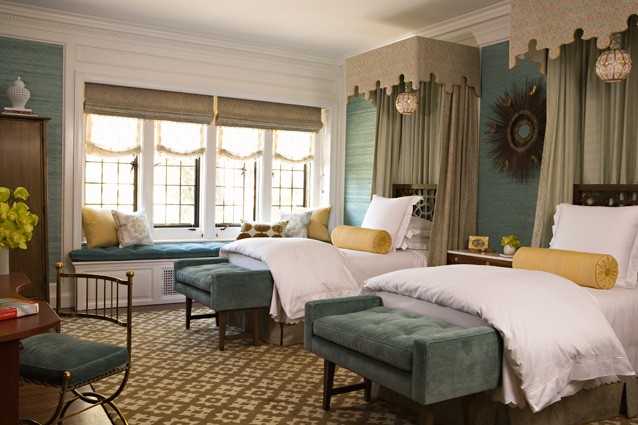
I love the blue-green shade of this grasscloth, which is picked up so perfectly in the velvet benches and cushions. And do I even need to mention the coronets or the gorgeous pendant lights above the two beds? ::sigh::

Suzanne Kasler

I gasped when I saw this dining room in the June issue of Traditional Home. It's just so, so beautiful. The subtle color strirations in the blue-gray grasscloth echo the shimmering waters of the lake the house sits on. The silvery-gold ceiling adds even more drama and elegance. Also, how brilliant is the mixing of the loop chairs with the Louis XV chairs?

The queen of "keep it pretty" has, once again, done exactly that. Incidentially, I believe that is my dream bed: a spare, architectural canopy paired with a lovely upholstered headboard and footboard.

I absolutely adore wainscotting, but it is true that it can often look rather formal. The addition of the grasscloth above the moldings, however, is a great way to bring some informality to the space as the deep blue grasscloth looks almost as though the walls were upholstered in denim.

Note how the grasscloth here is laid on the vertical rather than the more typical horizontal. These subtle vertical lines add height to a low ceiling and echo the bolder vertical stripes on the sofa.

For a more unexpected and thoroughly modern statement, why not try out purple or pink?

A beautiful example of how to really do up a guest bedroom properly. I'm a firm believer in experimenting in these seldom-used rooms. It's a wonderful opportunity to go all out with color, pattern, glamour -- whatever your heart desires. As for me, this room has given me a bad case of purple fever.


{source unknown -- email me if you know!}

I love the bold pink and lime color scheme in this room -- it's so Palm Beach! And also a refreshing change from all the blues and sands that are so typical of coastal interiors (though goodness knows I love my blues!).

And, just like any other wallcovering, grasscloth can be printed with a wide array of patterns, from geometric stripes and fretwork, to ornate damasks and florals.

Love this pretty aqua plaid from Schumacher. The aqua and chocolate brown palette is carried on throughout the rest of the room. I'm particularly fond of that two-toned rug.

Canadian House & Home

Pretty florals in a tone-on-tone pearl are a lovely, girly take on grasscloth. Note how the sofa too is a subtle tone-on-tone pattern, though this time in a more masculine geometric. This subtle tension between the walls and the upholstery create an interesting backdrop for the vivid pops of lime and hot pink.

This Moroccan grasscloth print (in blue!) from Phillip Jeffries has been on my "wish list" for our new home for months now. While I'd love to use it to paper the back wall of our breakfast nook, I know that practicalities dictate I find somewhere else to put it far, far away from the dinner table. And so, until I can think of a more sensible place to use it, I'll have to content myself with fawning over this lovely entryway.

HGTV's Design Star

This guest room, that the contestants decorated for Tiffani-Amber Theissen has got to one of my favorite HGTV rooms ever. The damask print on the grasscloth is gorgeous, and I love how they tempered its bold statement by keeping it on just one wall. My only critique would be to replace the seagrass rug with something else (maybe a bold navy stripe?) as it feels too matchy-matchy with the grasscloth for my taste.

So what about you? Are you as into grasscloth as I am? Have you tried it out in your own home yet or in a design project?

Tuesday, 4 May 2010

Style Essential: Turquoise Lamps

I've expressed my love of turquoise on this blog before, but I think one of the easiest ways to bring this bright, fun (and admittedly a bit trendy) hue into your home is through lighting. Prior to becoming an interior design amateur, I readily admit that I frequently ignored lighting. It just didn't seem important. Now though, I'm starting to believe that it might be the single most important element in a room. From a practical standpoint, good light is essential to good (and functional) design. From an aesthetic perspective, lighting (much like jewelry) can take the ordinary and inexpensive and transform it into something glorious. And so, as with jewelry, I'm a big believer in splurging on good lighting for a space.

But is the splurge worth it for a pair of turquoise lamps? I'd argue yes. Turquoise is perhaps unique among bright hues in its ability to work with a variety of colors. When paired with neutrals, turquoise accents are really allowed to take center stage. When paired with other equally bright colors (like purple, orange or green), turquoise is strong enough to really hold its own. I've said it before and I'll say it again: you should think of turquoise as a neutral.

I absolutely adore how Ondine paired these deep turquoise lamps with orange and that gorgeous suzani coverlet. The disparate color palette works because the walls are left neutral and all of the accent colors are equally saturated.

This room deservedly made the cover of House Beautiful a few months ago. The pops of soft blue work beautifully with the beige, but I think my favorite element in this space is the pairing of the striped wallpaper with the chinoiserie print (Lyford background by China Seas) and just that ever so subtle hit of zebra print on the throw pillows. It's a veritable master class in how to mix patterns.

I love how the lamp is the only bright color in this vignette. The peacock blue also picks up on the blue undertones of the wall paint.

In this room, turquoise is the primary accent color as its picked up in the majority of the soft furnishings, the lamps and in the artwork. I think turquoise is a great color choice for a master bedroom, as I think it appeals to both masculine and feminine sensibilities, especially when its paired with clean lines and little pattern as its done here.

I've waxed on about my love for this room in the past, but suffice it to say here that I'm still completely in love with these soft turquoise glass lamps, especially against the rich chocolate brown grass cloth on the walls.

Aside from the brilliant red of the roses, the pair of lamps on the buffet are the sole source of color in this room.

I love the height of this lamp, which really helps bridge the gap between the low furniture and the ceiling. The bright, citrus yellow of the walls can be tough to work with, but in the hands of Jamie Drake, the room feels sophisticated and grown-up, largely thanks to neutral furnishings, accented only by a few pops of turquoise in the lamp and throw pillows. The art work above the sofa ties the entire color palette together.

In this bedroom, I love how the bold turquoise of the lamp is picked up on the peacock-inspired throw pillow on the bed. By repeating this strong hue, the choice appears deliberate rather than accidental.

Melissa Warner of Massucco Warner Miller

This vignette, featured in the most recent issue of House Beautiful, is truly stunning. Not only do I adore the simple ceramic gourd lamp from Restoration Hardware, but just about every other element in here as well. I love how the detail in the cabinet doors is picked out in the soft blue and how the colors are picked up on the art work, which appears heavily influenced by the work of Rene Magritte, one of my favorite artists.

You can't get much prettier than this vintage Murano glass lamp. The blues in this bedroom are all very different, yet they work together beautifully. Don't be afraid to mix and match shades of the same color. The effect is eclectic, without being cacophonous.

The sea glass look of this large gourd lamp is the perfect -- and subtle -- beachy accent for this bedroom. Take a cue from Mrs. Howard and avoid filling this type of glass lamp with tchotchkes. I don't know why retailers are always encouraging this as I find the look to be entirely too cluttered (and the likely filler here, sand and shells, would take this room into theme territory).

If you're looking to bring a little turquoise light into your life, here are my top ten favorite that are currently available at retail:

Source List (from top left): 1. Art Glaze Floral Relief Lamp (Shades of Light; $299). A great way to bring some more texture into a room. 2. Paulette Lamp (Avid-Home; $337.50). A stylish shape that works equally well in traditional or modern interiors -- and the lucite base is fabulous. 3. Cane Turquoise Table Lamp (Clayton Gray Home; $290). Cane + turquoise = perfectly Palm Beach. 4. Capri Bottle Lamp (Jonathan Adler; $275). You can't get much more classic than this. 5. Stacked Ball Murano Lamps (Swank Lighting; $3000/pair). Jaw-droppingly beautiful (and if you're looking for vintage Murano lamps, Swank should be your first stop). 6. Blakely Glass Lamp (Avid-Home; $375). The neutral shade and more muted hue of this lamp means it will work seamlessly in more neutral rooms. 7. Jamie Young Co. Deauville Table Lamp, Sea Glass (Candelabra; $629). Delicate and oh-so-pretty, this one reminds me of the lamp in Jeffers' room above. 8. Peacock Lamp (Plantation; $365). Absolutely adore the color of this ceramic lamp. 9. Carnaby Hazard Lamp (Jonathan Adler; $225). A simple cylindrical shape is made interesting with a fun, retro pattern. 10. Pagoda Table Lamp (Clayton Gray Home; $350). The scale and shape of this pagoda lamp makes it perfect for a console table.