Showing posts with label Kara Mann. Show all posts

Friday, 7 May 2010

On My Mind...Upholstered Beds

Christina Murphy Interiors

I have a horrible habit of always being one or two projects ahead of myself. Even though I'm currently focusing on pulling together the living room (specifically, window treatments and built-ins -- update to come, I promise!), I can't help but find myself obsessing over my next project: the master bedroom. Once we complete the living room, I'll be tacking our master bedroom, the size and shape of which is so drastically different from our old master bedroom as to require almost an entirely new approach. While we're currently making do with a queen bed I bought in law school, the first item on my wish list is for a king sized mattress -- and an upholstered bed (or at least headboard) to go with it.

I've long been a fan of upholstered beds for their comfort as well as for the opportunity they create to bring in more pattern and color. Enough with the heavy, dark wood furniture suites; let's bring in some softness and color with fabric...and maybe a little sparkle with some fabulous nailhead trim! The bedroom above, designed by Christina Murphy, is a great example of the feeling I hope to crate in my master bedroom redesign. The room is luxurious and glamorous, but still comfortable and restful. The colors and patterns are interesting, without overwhelming the space. I particularly love how Christina pulled the orange and robin's egg blue from the fabric used on the headboard and bedskirt (and I love it when those match!) and use repeated them in the bedding's trim.

Melissa Rufty of MMR Interiors

The art deco shape of this headboard is extremely sophisticated, especially for a young girl's room. But its shape and neutral color ensures that it will transition easily from young girl's room to preteen to teen and beyond. Just swap out the curtain fabric, accent wall and bedding and you've got a whole new look with just a few simple changes.

Phoebe Howard

This might just be the perfect summer bed. I absolutely love the coral bedding with the neutral, textured grasscloth bed. The nailhead trim and sophisticated shape ensure that the bed looks like it belongs more in a Bahamanian plantation home rather than a humble beach shack. Note too the fabulous Baker Studio Marrakech side table with the coral underside: be still my beating heart.

Anne Coyle Interiors

This room reminds me of nothing so much as a modern take on the roaring '20s. There's just something about the lilac velvet and the fur paired with the dark blue walls and gilt frames that makes me think a flapper should be sleeping there. The bed's tufting and sloped arms feel like the bed version of a fainting couch.

Sara Gilbane Interiors

While the shape of this headboard is fairly simple, the gorgeously patterned fabric (which looks like a cross between a suzani print and traditional chintz) completely makes up for it -- as does the coronet bed drapes. Sure, it's a lot of look (and a lot of fabric) but it would definitely satisfy any childhood fantasy about a princess bed -- albeit in a more sophisticated manner.

Ruthie Sommers

Love the shape of this headboard -- it's subtle, but really beautiful. The chalky gray is so rich with the lilac side table and soft blues on the bed.

Lindsey Coral Harper

Another great shape in another all-purpose color. The contrast piping really helps pick out the details in the headboard, the curvaceousness of which is mimicked beautifully in the trim on the shams. I also love that Lindsey didn't go matchy-matchy here as the predominate colors in the bedding are black, white and rust while the headboard is the lovely chocolate brown.

Massucco Warner Miller

The more angular lines, brown fabric and brass hardware on this headboard feel much more masculine to me than most of the rest of these headboards, which is great for couples. My favorite bit about this room though is the fantastic trim on the coral euro shams. I think if I had seen that trim on its on in a fabric store, I would have dismissed it as '70s-tastic. And yet, Melissa Warner makes it look so fresh and modern in this room. It just goes to show you that it's often more about context than the thing itself.

Massucco Warner Miller

Another beautiful bedroom from Melissa Warner at Massucco Warner Miller. The shape of this bed reminds me of those large, overscaled leather beds from Restoration Hardware. The sort of armchair-turned-bed look that can so often read as heavy and masculine. Here though, Warner keeps it light with a buttery ivory leather and it looks magnificent against the metallic golden wallpaper and the coral accents.

Kara Mann

This silvery grey cotton velvet looks so absolutely delicious on this upholstered sleigh bed. The kind of fabric you just can't keep your hands off of. The velvet's texture is also beautifully countered with the silk duvet and pillows. Velvet and silk together sounds positively decadent, and it is, but the tailored, paired back styling keeps the bedroom from drifting into the boudoir. Besides, if there's any place in a home more appropriate than a bed for pure, tactile pleasure, I don't know where that is.

Courtney Giles

Even a solid-colored headboard can make a tremendous statement against a high contrast wall. The higher the headboard, the better in my opinion. This room is also a great example of how black walls can actually make a room look bigger and brighter than it really is.

Mary McDonald

Like everyone else in blogland, I went ga-ga over Mary McDonald's pagoda headboard in her guest house (featured in domino back in 2008). My only criticism is that the moon on the wall looks rather like an off-centered moon atop the headboard itself -- and I find it distracting. I think Mary would've been best advised to scrap the wall art altogether (or keep it to the figures on either side of the bed). That said though, this still ranks high on my all-time favorite bedrooms.

Katie Ridder

I went ga-ga for the shape of this headboard when I first saw it last year. Perhaps my favorite element though is that this bed is both upholstered and spare and architectural. Truly the best of both worlds.

Annie Selke

So here's a shot of my absolute favorite upholstered bed. It's Annie Selke's Salado bed and the headboard version is available through Horchow. Of course, I'm not too keen on the price (especially for just the headboard and that you can't pick the fabric!) so I think I'm going to try and have the shape copied in the fabric of my choice. Right now, I'm leaning towards Windsor Smith's crisp, fresh seersucker.

Thursday, 11 March 2010

Formal Dining Rooms


Earlier this week Cristin posted about decorating dining rooms over at Simplified Bee and it's gotten me itching to start decorating my own dining room (to get a feel for what I'm going for, see HERE). When we first moved in, we managed to paint out the trim on the lower third of the room to resemble wainscoting and paint the balance of the walls a deep blue (Farrow & Ball's Drawing Room Blue), but that's all the progress that's been made so far -- and unfortunately, until my budget recovers, that's all the progress that's going to be made for quite some time.

But that doesn't mean a girl can't day dream, right? In fact, I'd say a temporary cash crunch can be a good thing for designing a room as you're forced to window shop in favor of actually, well, shopping. This forced abstinence allows you the time to really get a feel for what you love most (rather than what you love today or what your budget allows you to buy today). And, when you finally do have the luxury of going out and buying new pieces, having curtains made, etc., you know the market, the trends and what it is you're really after.

So here are a few of my absolute favorite dining rooms, collected over the past few months as I continue to contemplate the transformation of my small dining room into something truly spectacular.

For me, a formal dining space should be exactly that: formal. It should also be luxurious, dramatic and special. After all, these rooms are for special occasions, most of them occurring at night. So I say work with that and go for lots of drama: crystal, gilt, mirrors, silks, velvets, dramatic colors, hand painted wallpapers...you get the idea. If you're looking for a good guide on how to incorporate all that and more without making the room feel overdone or too stuffy, you need look no further than Kara Mann's gorgeous gray dining room (above) that was featured in last month's Traditional Home. I particularly love the silver-leaf finish on the mantle against the Carrera marble surround.

There are those that argue that formal dining rooms are dinosaurs; that the modern family does not need to distinguish between public and private rooms, formal and informal settings. And that's certainly true to an extent, but at the same time I love the idea of the luxury of having a formal dining room. The luxury of having a place at home to celebrate truly special occasions. The type of room that is filled with memories yearound, even if it is only "used" a few times a year (though certainly there is nothing stopping you from using your formal dining room -- and your formal china -- on a regular basis, and I completely encourage this!).

In this dining room designed by Hillary Thomas, I love how the trim and wainscoting is painted out in a high gloss sage green. It's such a great way to modernize very traditional architecture (and the very traditional wallpaper). The glossy green also works well with the dining chairs, which are done in a high glass black with a sage green seat.

Ruthie Sommers

Wainscoting and wallpaper (especially handpainted wallpaper) are two of my favorite design elements for a formal dining room. The sea grass rug and lack of window treatments make this room feel much lighter than many of the others -- and also more approachable. For me, this room is the perfect balance between formality and luxury, on the one hand, and practicality and comfort, on the other.

Christina Murphy

A simple formula for high drama in a dining room is dark bare wood floors, metallic wallpaper and a crystal chandelier. The mirrored insets into the paneled doors is a simple and inexpensive way to add a little extra sparkle and to dress up an otherwise standard feature. I also love the Kartell Mademoiselle Chairs, with their lucite legs and low backs.


Here, I love how the dark slate walls contrast with the high impact turquoise chandelier and hot pink upholstered dining chairs. I think my first inclination would be to pair colors like this with a predominately white backdrop, but Katie demonstrates here how success dark walls with bright furnishings can be. I also like how she kept it from feeling too cave-like by having a lighter colored rug on the floor. This lightness is similarly reflected on the ceiling, which appears to be papered in a subtle tonal damask.

Pastoral murals in dining rooms are very, very traditional. In fact, you can see many fine examples of them in homes in Pompeii. Here though, the brighter colors in the mural and in the fabrics lend a rather whimsical quality to Thad Hayes' space. So much so that it feels almost cartoon-like.

Anyone else remember Ondine from the second season of Design Star? [By the way, is that show ever coming back? I loved it!] In any case, Ondine is back and in the running for Traditional Home's Young Traditional Designer of the Year. Flipping through her portfolio, I fell in love with this dining room. I love the juxtaposition of the almost Medieval architecture with the vibrant pinks. In fact, I'd happily steal that set of Ikat chairs and the hot pink buffet for myself. How fabulous would that look against navy walls?

Nathan Egan is one of my favorite designers for subtle drama. Rooms like the dining room above show that you don't need bold colors or expensive, embroidered wallpaper to make a big impact. I also love how the oversized photograph is hung between the wall and wainscoting. The gesture feels almost haphazard, but the effect is incredibly striking. I also love the large wine barrel chandelier -- sure, it's been trendy, but there's also a nice rusticity about it that works so well with more traditional interiors.

One of my all-time favorite dining rooms, by the near-faultless Suzanne Kasler. While I usually prefer trim painted-out white, the blue lacquer that Suzanne applied to both the walls and trim here is incredibly striking. I also tend to prefer matching chairs (or at least matching side chairs with a pair of larger chairs for the ends), but yet again Suzanne proves here there's no "rule" that I can come up with that can't be successfully broken.

This dining room was featured in a spread House Beautiful did last year on a beach house Annie Selke decorated and I absolutely fell in love with all of it. I love the mix of patterns here as well as the mix of blues. A deft hand is needed for this type of mixing, but Selke is skilled at mixing both patterns and colors in a way that feels very modern, without any of the eclectic-bohemian element that I'm admittedly not a huge fan of.

Thursday, 25 February 2010

Anatomy of a Console Table


Generally speaking, there are precious few "rules" when it comes to decorating. After all, taste isn't really a matter of following a prescribed list of "do's" and "don'ts", but instead a more elusive art form: it is emotional rather than logical. There's an often repeated mantra that good taste can't be taught -- and perhaps that is in fact the case. However,I firmly believe that if we take the time to train our eyes, we can learn short cuts and handy tricks that can at the very least help us approximate good taste, even if it isn't innate.

One area of decorating that appears to have surprising uniformity is styling a console table. A console table is the true workhorse of occasional tables -- it works equally well behind a sofa as it does in foyer -- and it's also an amazing opportunity to practice styling on a small scale. For many designers, the task can even be broken down into a rather simple arithmetic formula. Take for example Sara Gilbane's alcove (shown above). The classical elegance of the console table is anchors the statement-making gilt mirror. A pair of tall vases flank either end of the table and help bridge the space between the mirror and table top. Smaller-scaled picture frames and a decorative bowl fill in the center of the table and create further symmetry. This symmetrical arrangement is then echoed on the lower shelf with two small plants flanking the inlaid box.

Following this symmetrical formula is a simple and guaranteed way to achieve a visually pleasing arrangement. A few more examples from some of my favorite designers to illustrate some of the many variations on this theme:

Hillary Thomas Designs

John Willey Interior Design


Meg Braff

Ashley Whittaker

Miles Redd

If you have a longer wall to fill, follow the lead of Miles Redd (above) and Sally Steponkus (below) and try flanking the console table with a pair of smaller chairs. When company comes, you'll have the extra seating, but otherwise the chairs will be out of the way for day-to-day activities.

Sally Steponkus

If you're ready to move on to the next level, try breaking up the symmetry a bit, which can create a far more interesting (and less "decorated") look. The key to your success though will be to maintain the balance. Here, Kristen Hutchins uses only one table lamp (a good choice as the console table is on the small side), but balances it with a small floral arrangement at the other end.


Here, the very symmetrical arrangement of mirrors above the console is loosened up by the more haphazardly arranged orange boxes below. If the boxes had been stacked more tidily, the overall effect would have been far too geometric, which would have felt too studied and not in keeping with the more organic qualities of the decorative objects on the table itself.

Ruthie Sommers

If you're trying to break up the symmetry a bit, I'd suggest keeping at least one element symmetrical, as Ruthie Sommers did here with the pair of sconces flanking the mirror. This is a simple trick to bring balance back to an asymmetrical space. [Random aside: Did you notice the adorable dog lounging on the stairs in the mirror's reflection?]

Lindsey Coral Harper

Sometimes a simpler, less cluttered arrangement is best, particularly in a small entryway or hallway. Here, Lindsey puts the emphasis on the vertical space of the room rather than the horizontal by using highly reflective elements (the metallic wall paint, the gilt mirror, the glittering wall sconces). The effect is further realized by placing the mirror and sconces higher up on the wall. A word to the wise though: when hanging wall art, mirrors, sconces, etc. it's best to keep them below the height of the door or window frame.


Time for the masters' class! In this vignette by Tim Clark, nothing is symmetrical and yet the arrangement is still highly successful. The red rattan chair is balanced by the palm in the red pot and the height of the pot is similar to the height of the floor lamp behind the chair. The green stools echo the color and shape of the small vases on the opposite side of the console table. As each side speaks to the other, the eye moves back and forth across the vignette.

Amanda Nisbet

A final point to consider is that sometimes fewer, larger pieces are far more effective than a bunch of small tchotchkes. In this vignette by Amanda Nisbet, the scale of the mirror, lamp and bust create a lot of drama without creating a lot of visual clutter. The neutral palette also ensures that these disparate pieces work harmoniously together.

Friday, 29 January 2010

Be Bold, Go Blue.

There seems to be a general resistence in the design world to decorating a kitchen in anything other than neutrals or whites -- probably because of the expense and difficulty of overhauling a kitchen should you decide just a few years later that you're no longer so enamored with, say, peach. And that's fair. I, too, eskewed bolder choices in favor of safer, buyer-friendly selections when I designed my kitchen last spring. But the end result is that, while I like my kitchen, I don't really love it. So I wish I'd stretched myself a bit more, been a bit bolder with my choices and maybe gone with, say, a blue kitchen.

The great thing about a blue kitchen is that, while it's a bit of a departure from the oft-used white, it's still fairly traditional. Nobody is going to think you've gone completely off your rocker and there's a good chance that you'll still love it in a few years' time. And even if you don't, repainting cabinets (or riping out backsplash) isn't the enormous hassle or expense that it's often made out to be.

One of my all-time favorite kitchens is this one by Sherrill Canet (shown in two photos above). Of course the towering cathedral ceilings probably have a lot to do with it, but I also love how Sherrill used a lighter blue on the wall cabinets and a darker blue on the island to anchor it in the space. My favorite element though is the glimmering stainless steal subway tile backsplash around the oven and the gorgeous stainless steel hood.

Elle Decor

This kitchen deservedly made the rounds in the design blogosphere when it first appeared in Elle Decor. I love the contrast of the large white island with the indigo wood floors and cabinets. The pendant lights and the milk glass chandelier are also envy-inducing.

Massucco Warner Miller Designs

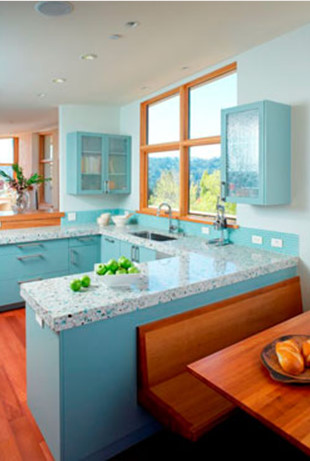
A more modern take on a blue kitchen. I absolutely adore the (Silestone?) countertops and backsplash. The reddish tones in the natural wood floors and trim are a great contrast to the stainless steal and the cool blue of the cabinets.

Michael J. Williams

This kitchen from Michael J. Williams was featured in the latest issue of Traditional Home. As a brief aside, if you haven't picked up the February issue of TH yet, I highly suggest you do. Between the spread on Ruthie Sommers' latest work and Kara Mann's, it's one of the best issues I've seen from any shelter magazine in quite some time. Both spreads are also so reminiscent of domino that I found myself flipping back to the cover periodically just to make sure I wasn't hallucinating and reading a "new" issue of domino. In any case, the blue on this island is almost a chambray and it's this denim-like quality that I think really gives the space a laid back, family-oriented vibe.

Retro Renovation

This kitchen is retro to the point of kitsch, but turquoise and red always make me smile.

domino

When this kitchen first appeared in domino a few years ago, it made me desperate for a chandelier in my kitchen. I love the contrast between the ornate black glass fixture and the sleek and modern kitchen.

House Beautiful

I love the deep royal blue featured on all the cabinetry -- it works so beautifully with the pops of bright citrus that the stylist brought in for the shoot. The color choice here is undoubtedly brave, but it's what elevates this kitchen into magazine-worthy status. The designer also wisely kept the rest of the kitchen quieter with classic Carrera marble counters and backsplash. Matching your counters to your backsplash is a great way to create a seamless and sleek look, which is ideal if you've got a lot of "look" going on elsewhere in your kitchen.

Frank Roop

The Ann Sacks tile featured on the backsplash in this kitchen makes me a bit weak in the knees. It works perfectly with the sleek gray (soapstone?) countertops without feeling overly match-y. I think backsplash is a great way to bring color into a kitchen if you don't want to go for a bold color for your cabinetry. If your tastes change, it's also not nearly as onerous to replace.